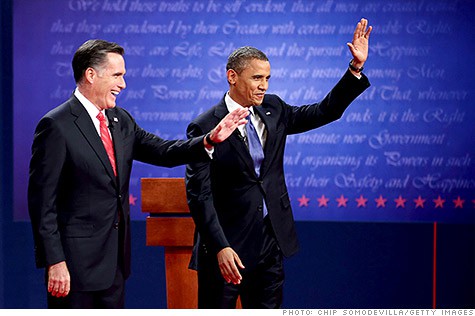





The biggest—most disappointing—problem we’re facing in the presidential debates so far? The lying.
The whole point of having debates is to be able to compare and contrast the priorities, policies and politics of the major candidates. But this is all based on the assumption that both candidates tell the truth, both about their own positions and their opponent’s. My takeaway from the debates—and much of the campaign season to date—is that this is often not the case. And if these debates are not primarily honest arguments addressing reasonably accurate realities, then they become little more than theatrical performances.
In that case, I’d rather spend my time watching John Stewart and Bill O’Reilly debate. Apparently that exchange—aka the “Rumble in the Air-Conditioned Auditorium”—was more honest, and it was certainly far more entertaining.
“Truth” can be defined as “that which is in accordance with fact or reality.”
That being said, there are three sets of truths we need to hear discussed in these debates:
-
The truth about the problems we face, with no sugar-coating or fear-mongering included. The candidates will differ on how they define and prioritize different issues, but they should be honest and consistent when doing so.
-
The truth about the possible solutions to these problems. We need to understand both the strengths and weaknesses of different approaches, along with the necessary sacrifices and tradeoffs (e.g., both candidates talk extensively about clean coal, even though there is no such thing).
-
The truth about each candidate’s views and track record, as well as how they portray their competitor’s views and track record. We want candidates who hold reasoned principles and positions, not Etch-A-Sketches.
“Falsehood” can be defined as “the state of being untrue.” A lie is “an intentionally false statement,” and deceit is “the action or practice of deceiving someone by concealing or misrepresenting the truth.”
Both sides are guilty of these things. Many reports point to Gov. Romney as being the more dishonest one in the first debate (it’s ironic since at one point he chided President Obama by saying, “You’re entitled … to your own airplane and your own house, but not to your own facts.”
Still, it’s hard to objectively judge which campaign has been more dishonest overall, as Michael Scherer thoughtfully explains this week in an online article for TIME magazine.
At the end of the day, however, the final tally doesn’t really matter that much. Both campaigns and both candidates have run afoul of fact-checkers far too many times and in far too many ways.
This has become a systemic problem because campaigns and politicians rarely face consequences when they distort the truth. To the contrary, it often helps them get ahead politically. They count on listeners remembering the zingers during a debate (or an ad, for that matter) without figuring out—or even particularly caring—whether the assertions are fair or accurate. As the old proverb tells it, a lie will go around the world while the truth is still pulling its boots on.
So here’s an idea: Let’s introduce consequences for lying in the debates. Let’s set up a rigorously independent commission of fact-checkers (staffed perhaps by organizations such as FactCheck.org and PolitiFact) that referees the debates live. Every time the commission catches a candidate promoting something untrue, they fine the candidate and give that money to the competitor’s campaign fund. Fines could vary according to the degree of deception, ranging from “half true” to “pants on fire!” They could even add a news ticker across the bottom of the TV screen to keep a running tally of just how much money each candidate is donating to the other.
Maybe that will incentivize politicians to take their claims more seriously. At the very least, it will be a lot more entertaining for us viewers, and it will help us keep track of what’s really going on.
Now, I know that idea is not terribly practical, and I’m not holding my breath for some other creative solution to be implemented. However, while truth is a casualty in the debates and in politics, it doesn’t have to be a casualty in the church.
As Christians, we can pray for wisdom and discernment and to be shrewd as serpents and innocent as doves (Matthew 10:16). We can recognize how much deception usually takes place on both sides and work together, especially during election seasons, to seek out and understand what is true and what is false—intentionally fostering the former while graciously exposing the latter—even if it doesn’t seem to favor the candidate or the position we support.
And, for the sake of our sanity, we can encourage one another to stop passing along those shameful ideological email forwards that keep stirring up confusion and alarm. Now, wouldn’t that be nice!